Australia's AI Productivity Paradox
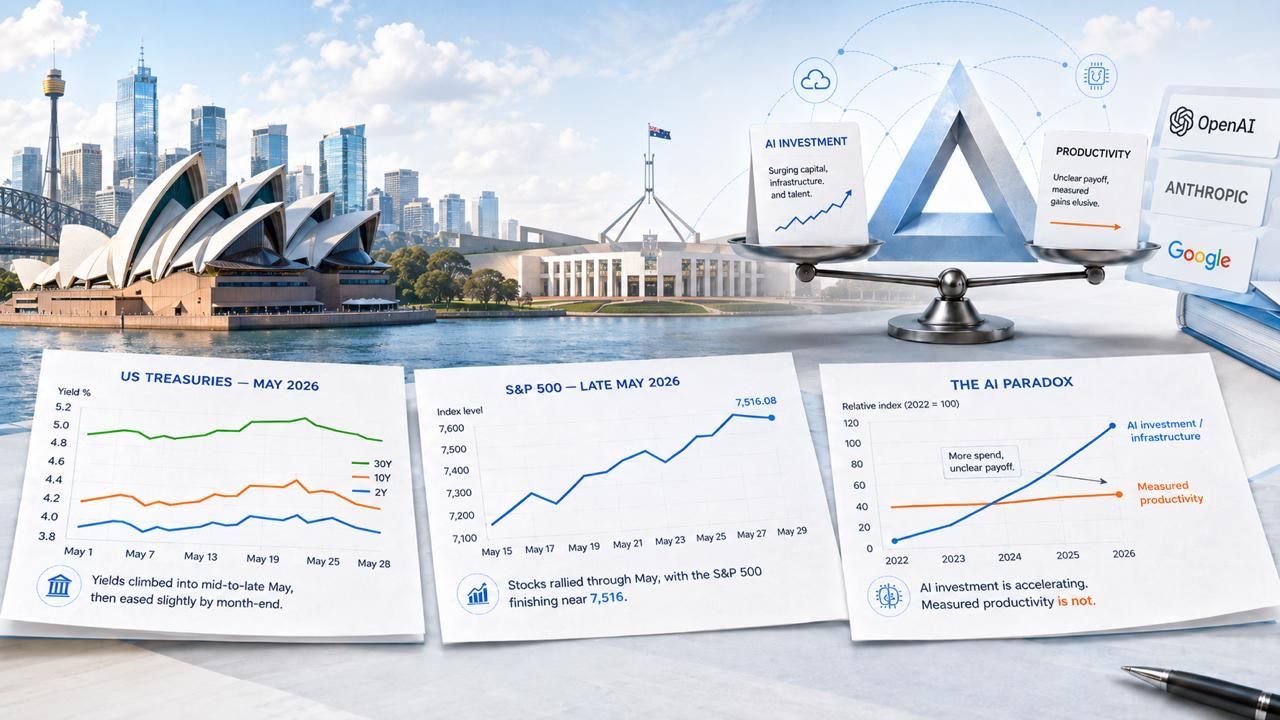
There is a lot of commentary from senior politicians about how AI is going to help solve Australia's productivity woes. Ed Husic put it fairly plainly back in 2023: "Australia will only see the benefits of AI in productivity statistics if we can boost adoption." Which is the more polished ministerial version of "Australian businesses need to embrace AI or risk being left behind", etc, etc. The federal government showcases its meetings with Sam Altman, Satya Nadella and Dario Amodei, and points to the current unprecedented data centre build-out as evidence that Australia is on the path to becoming an AI powerhouse. The National AI Plan talks about "capture the opportunity", "spread the benefits" and "keep Australians safe", which is all hard to disagree with in the same way it is hard to disagree with cavoodles, clean beaches and children not vaping. But as a productivity strategy it's rather abstract.
I see a few problems with this, the first being that I don't think there is a large pool of unemployed tradies that we're suddenly going to tap into to build these data centres. Nor is it likely that large numbers of white-collar workers displaced by AI are suddenly going to re-apprentice into the trades. I'm not saying data centres create no jobs. They clearly do. But if the productivity argument is that AI displaces one kind of labour and data centre construction absorbs another, then I'm not sure that is a national strategy so much as a category error with a ribbon-cutting ceremony attached.
Secondly, these things need a lot of energy, and we've not managed that particularly well in Australia. Nor is that likely to change any time soon. Zero-emission targets also seem to get a lot less attention now that AI needs so much power. Maybe we are hoping AI solves fusion power, invents cost-free carbon capture, fixes transmission, explains Snowy 2.0, and gets everyone to agree on nuclear. I don't know what the solution is, but we can already see the mess this is creating in the US, so I'm not sure why we are confident it won't create the same problems here.
Thirdly, it doesn't solve the sovereignty issue. Data residency is not the same thing as data sovereignty. Putting the building in Sydney or Melbourne does not magically make the system sovereign if the owner sits under the US CLOUD Act, or under China's broader national security and intelligence law framework. How problematic is that? Well, Jeff Bezos described Donald Trump as a more mature, more disciplined version of himself. Read that however you like, but it seems unlikely that big tech is going to throw itself heroically in front of Australia's claims to sovereignty.
The other problem is that the current market valuation of big AI is not based on AI being a tool to enhance individual productivity. It's valued, at least in part, on the assumption that it will replace a lot of labour and capture a lot of margin. I don't necessarily believe it will do this, but the amount of money being thrown at this means the economics have to change. Frontier token costs are likely to go up a lot, maybe ten times or more, and if companies have built workflows that are heavily dependent on these models, they are going to have to look for savings somewhere. That somewhere is likely to be jobs.
All in all, I think Australia is walking blindly into something that may not improve our productivity at all, or at least not in the way politicians are currently describing it. We seem to be confusing three quite different things: AI as a productivity tool, AI as a foreign-owned infrastructure build-out, and AI as a labour substitution engine. The public conversation is mostly about the first. The investment announcements are mostly about the second. The market valuations and public fears are largely about the third.
So what do I think we should do? Firstly, we just can't build a lot of data centres without solving the energy issue. We should not confuse "large foreign company wants to plug an enormous industrial load into our grid" with a "national productivity strategy". Satya mentioned the importance of operating these data centres with a social licence, but unlike the US we don't have any decommissioned nuclear power stations lying around to reactivate.
Secondly, we need to stop with the scaremongering and trashing of Chinese open-weight models and start encouraging Australian businesses and bureaucracies to understand, train, fine-tune and operate open-weight models locally. The training-data objections are not especially convincing either. It seems likely that the Chinese models leaned heavily on US models and data for training, without permission — but the US models used all of our data for training without permission. Absolutely, do not run sensitive workloads in Alibaba Cloud. But there is a fairly large difference between sending your data to a foreign cloud provider and running an open-weight model under your own control, on Australian-owned infrastructure.
The Australian government could do something genuinely useful here: create safe reference architectures, approved deployment patterns, model evaluation frameworks, procurement pathways and Australian-hosted capability for open-weight models.
Thirdly, we need to stop treating AI adoption as a training issue. AI improves productivity when organisations redesign work around it. Government and enterprise seem to love taking a transformative technology and wrapping it in procurement, governance, risk committees, consultation papers, steering groups and a pilot that starts 18 months after everyone else has already learned the hard lessons. We need to stop pretending that rolling out Copilot is organisational transformation.
Lastly, the rate of AI deployment into government has to keep pace with the private sector, or the productivity problem may actually get worse. If private businesses use AI to reduce headcount and compress workflows, but government remains largely unchanged, then a smaller private-sector tax base is left supporting the same, or larger, public-sector cost base. At the same time, the bottleneck simply moves. Approvals, regulation, compliance, procurement, reporting and service delivery become slower by comparison. If that gap widens far enough, GDP growth, tax revenue and debt sustainability all start pointing in the wrong direction.
That is the productivity paradox: we may be adopting the technology quickly enough to disrupt the economy, but not thoughtfully enough to make the country more productive.